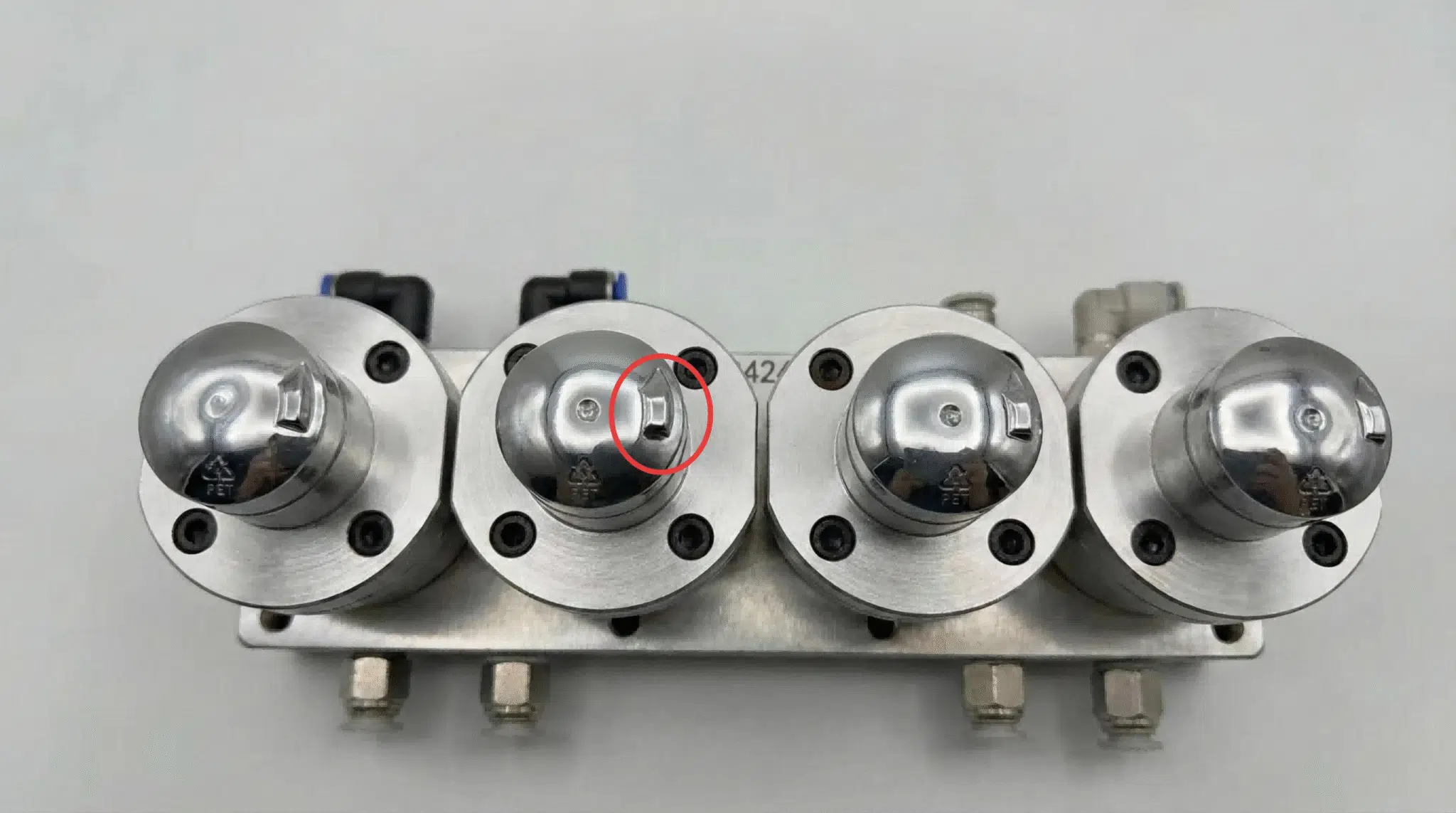
Every second your production line stops burns through your net profit. Misaligned labels are one of the most common invisible killers of filling line efficiency and packaging material conservation. Have you ever calculated exactly how many rolls of expensive label stock and how many blown preforms your factory wastes annually due to alignment issues?
In the era of high-speed automated production, any microscopic error is amplified by speed into massive financial loss. A bottom orientation notch is the only irreplaceable physical lock between the bottle base and the labeling equipment. It completely eliminates random rotation of the bottle during high-speed conveying. By using mechanical force, it ensures the bottle enters the labeling station at an angle precise to the millimeter. This is not just the only low-cost solution to ensure labels apply to flat surfaces, avoid parting lines, or respect key bottle designs; it is an indispensable mechanical feature for high-speed automated packaging. For any non-round bottle or any round bottle where appearance is paramount, a bottom orientation notch is not an optional extra—it is a mandatory requirement for production viability.
A bottom orientation notch acts as a mechanical anchor, locking your bottle into a fixed position on the conveyor. This forces the bottle to face the labeling machine correctly every time, ensuring labels apply perfectly to flat surfaces or specific areas, preventing defects on high-speed lines.
The Core Problem: Controlling Bottle Rotation on the Line
On a high-speed beverage or home care product production line, the time between a bottle leaving the bottle blowing machine and entering the final shipping case is a chaotic physical journey. The bottle spends most of this time in a "free state." This is a battle involving friction, centrifugal force, and inertia.
When bottles move on a slat chain conveyor, the vibration of the chain causes the bottles to shift slightly. When they transfer rapidly between star wheels, massive centrifugal forces cause the bottles to spin uncontrollably. For a standard round mineral water bottle, this rotation is usually acceptable because the bottle is axially symmetric—the label looks the same regardless of which side faces out. However, the moment you require fixed-point labeling, this randomness becomes catastrophic.
In my professional career, I have seen too many factory managers overlook this in the early stages of a project. They invest huge sums in world-class filling equipment but try to save money or effort on the "small detail" of mold design by removing the bottom orientation notch. The results are brutal. When a shaped bottle—like a flat shampoo bottle—reaches the labeler, inevitable vibrations on the conveyor belt cause the bottle to twist just 10 to 15 degrees. The labeler’s sensors cannot detect this slight physical deviation and apply the label according to the preset program. The result is a label applied over the corner ridge of the bottle, or a label hanging half-off in the air. This creates unsightly wrinkles and flagging labels, and often causes the entire batch to be scrapped, forcing operators to stop the machine for manual cleaning.
I often tell my clients that relying on guide rails on the sides of the conveyor to "squeeze" the bottle straight is unrealistic. That is an amateur approach. Relying on friction from rails to correct orientation is highly unstable. If there is even a drop of condensation on the bottle surface, or if the conveyor speed changes slightly, the friction coefficient changes, and the bottle will still twist. For automated production aiming for high OEE (Overall Equipment Effectiveness), physical control is always superior to electronic correction or frictional correction. While vision systems exist to assist with orientation, reliable high-speed vision systems are expensive, complex to maintain, and picky about lighting and bottle transparency. In contrast, a mechanical orientation notch provides the most fundamental, lowest cost, and most reliable physical constraint. It turns "uncertain" rotation into "certain" mechanical engagement.
What Exactly Is a Bottom Orientation Notch or Lug?
From a strict engineering definition, a bottom orientation notch is a specific geometric feature formed by the mold in the base push-up area of the bottle. It serves as the interaction interface between the bottle and the external machinery (the labeling machine). This interface must possess sufficient mechanical strength to withstand the instantaneous torque of high-speed rotation without destroying the pressure-resistant structure of the bottle base itself. This is not as simple as digging a hole in the bottom; it involves precise fit tolerances.
Depending on the specific design of the labeling machine puck and the application scenario of the bottle, this feature generally falls into several main categories. The most common is the Recessed Notch, which is a long strip or wedge-shaped structure indented into the bottle. It is designed to accept a spring-loaded pin on the puck. The advantage of this design is that it does not protrude beyond the bottom plane of the bottle, so it does not affect the stability of the bottle when placed on a table.
Another common design is the Side Ramp. This design features a gentle lead-in slope and a vertical stop face. It allows the orientation pin to slide smoothly into place as the bottle rotates, rather than impacting directly. This is particularly important for high-speed lines.
In some heavy-duty container designs or wide-mouth jars with thick walls, we also use the Protruding Lug, which is a solid block sticking outward. This structure is extremely strong but requires a dedicated conveyor puck to accommodate the protrusion.
When designing a blow bottle mold, I pay special attention to the "lead-in" capability of this feature. You must consider the actual operating speed of the machine. If the line speed reaches 30,000 bottles per hour, the impact force of the positioning pin hitting the notch is staggering. If the design is too steep, the pin will strike the plastic wall like a hammer, causing the bottle base to turn white instantly or even crack. Therefore, an excellent notch design must include a smooth lead-in angle to guide the pin gently into the locked position rather than colliding harshly.
Comparison of Orientation Feature Types
| Feature Type | Geometric Description | Typical Application | Detailed Pros & Cons Analysis |
|---|---|---|---|
| Recessed Notch | Rectangular or trapezoidal slot in the push-up. | Most flat bottles, square bottles, shaped beverage bottles. | Pros: Does not affect standing stability; mold machining is relatively simple; high universality. Cons: If designed too deep, it severely weakens the base strength; prone to stress concentration at the root. |
| Side Ramp | Smooth transition (30-45°) on one side, vertical lock on the other. | High-speed lines (>20,000 BPH). | Pros: Drastically reduces mechanical shock; smoother operation; lower noise; extends the life of machine probes. Cons: Mold machining is slightly more complex, often requiring 5-axis CNC for fine detailing. |
| Protruding Lug | Solid block protruding from the base surface. | Thick-walled bottles, large capacity jars. | Pros: Strongest mechanical engagement; solid structure; resistant to wear or deformation. Cons: Bottle cannot stand flat on standard conveyors; requires specialized pucks with recesses. |
Critical Application: Which Bottles MUST Have It?
Not all bottles require this feature, but for certain specific designs, it is mandatory, with no room for compromise. If you are developing a non-round bottle, or a round bottle with extreme appearance requirements, an orientation notch is a rigid necessity. This is a hard requirement regarding geometry and mechanical alignment. Ignoring it is equivalent to choosing low-quality production.
For Square or Rectangular Bottles, the need is obvious. These bottles have defined front and side faces. The label must apply to the flat surface. If there is no orientation notch, and the bottle rotates even 5 degrees during conveying, the label will bridge across the corner edge, creating what we call a "tenting" effect. This defect is unacceptable to consumers on the shelf; it directly conveys a message of cheapness and poor quality.
For Oval or Flat Bottles, the situation is even more complex. The front and back surfaces of these bottles usually have a small curvature suitable for labeling, but the side curvature is extreme (small radius). If the alignment is off, the label edge extends into the high-curvature area of the side. The tension of the label paper itself makes it impossible to adhere, inevitably resulting in wrinkles and bubbles.
Even Round Bottles, which seem like they wouldn't need orientation, often require notches in the high-end market. I once designed a mold for a premium mineral water brand that demanded absolute perfection. The client explicitly required the label to avoid the mold's "Parting Line." Because the parting line creates a microscopic ridge, applying a clear label over it leaves a visible white line or air bubbles, ruining the visual transparency. By using bottom orientation, we forced the parting line to sit behind the label or in the gap between two labels, achieving a flawless visual effect. Look at expensive Evian water or premium vodka; their labels are always applied perfectly without covering the mold line. This is the work of the orientation notch.
Furthermore, bottles with Handles or Embossing must be oriented. You absolutely do not want a label applied over a handle, or covering a relief logo you paid a fortune to mold. This is not just an aesthetic issue; if a handle is taped over, it affects user experience and safety. In these applications, the orientation notch acts not just for labeling, but as the datum point for the entire downstream packaging process, including case packing orientation.
How It Works: The Mechanical Interaction
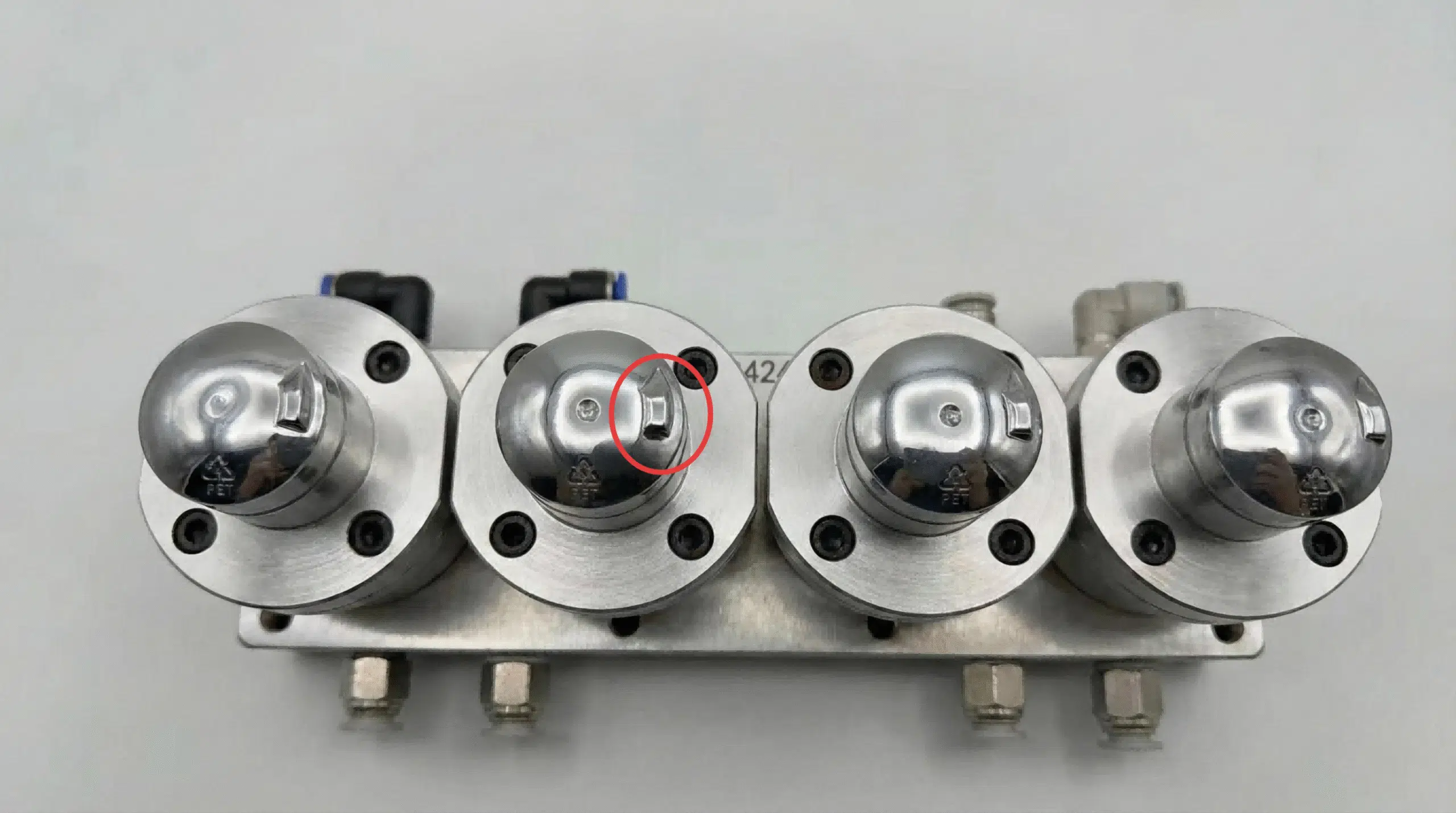
Understanding the mechanics of the orientation notch helps us make smarter decisions during mold design. In a typical rotary labeling machine, the bottle is fed into a star wheel and sits in an individual base, known as a Puck. This process is dynamic and high-speed.
When the bottle enters the station, the puck begins to rotate rapidly, driven by a servo motor or mechanical cam. The puck is equipped with a spring-loaded pin or a fixed block. As the bottle spins, this pin slides along the flat plane of the bottle bottom, searching for the notch. Once the pin slides into the notch, the bottle is mechanically locked and stops rotating relative to the puck. At this moment, the orientation of the puck is known (controlled by the machine encoder), and therefore the orientation of the bottle is fixed. The machine then rotates the bottle to the precise labeling angle, and the label application mechanism engages to apply the label.
The specific mechanical action breaks down into these critical steps:
- Entry and Support: The bottle transitions smoothly from the slat chain to the main labeling carousel. The bottom sits completely in the puck. At this point, the bottle direction is random.
- Phase Search: The puck begins to rotate quickly. The orientation pin on the puck is pressed against the bottle bottom plane, sliding. This requires the bottle bottom plane to be flat and smooth, without high gate residue.
- Mechanical Capture: When the positioning pin rotates to the notch position, it snaps into the recess instantly under spring force.
- Buffering and Locking: The pin slides down the "lead-in ramp" of the notch and presses tightly against the vertical "stop face." Now the bottle and puck are fully synchronized with no relative slip.
- Oriented Labeling: The machine calculates the precise moment the bottle face is in position based on the puck's encoder data and drives the label station to dispense.
- Release: After labeling is complete, the bottle is ejected from the star wheel, and the puck resets, ready for the next bottle.
During the design phase, I always ask clients for the specific parameters of their labeling machine. What is the size of the pin? Is it round or square? What is the spring force? If there is a mismatch—for example, if the pin is larger than the notch, or the notch is too shallow causing the pin to slip out under high-speed centrifugal force—positioning will fail. For projects requiring extreme precision, we strongly recommend clients perform from 3D printed samples to production testing. We print a sample base and run it on the actual production line to confirm the fit of the locking mechanism.
Design Geometry: Depth, Radius, and Draft Angle
Designing an orientation notch is a balancing act between "mechanical function" and "molding process." Many inexperienced mold designers will draw a deep slot with right angles, thinking this locks the tightest. In the real world of injection and blow molding, this is a mistake.
First is the Draft Angle. The orientation notch is formed by protruding metal on the bottom mold. If the side walls of this metal block are vertical (0 degrees), the plastic will grip it tightly as it cools and shrinks. When the bottom mold pulls away, the immense friction will drag against the plastic, causing "drag marks," whitening, or deformation. I generally recommend maintaining a draft angle of at least 3 to 5 degrees. For notches deeper than 3mm, angles of 7 degrees or more are necessary to ensure the bottom mold exits silently and smoothly.
Second is the Radius. Sharp internal corners are stress concentrators. PET material is very sensitive to stress. If the bottom of the notch has a sharp corner, cracks will initiate and propagate from there instantly when the bottle is dropped or pressurized, leading to rupture. We must use a radius of at least R0.5mm or even R1.0mm at all transitions. This not only enhances the bottle's drop resistance but also facilitates the flow of molten plastic during the injection of the preform mold, preventing air traps.
Depth is also critical. If the slot is too shallow (e.g., less than 1.5mm), excessive centrifugal force during high-speed rotation causes the pin to jump out, leading to orientation failure. If the slot is too deep (e.g., greater than 4mm), it causes the bottle wall at that location to stretch too thin, or conversely, causes material to pile up too thickly around it. Uneven material thickness leads to inconsistent cooling, resulting in severe shrinkage deformation, rendering the notch inaccurate.
Below is our recommended parameter table, based on years of field experience:
| Critical Parameter | Recommended Range | Engineering Logic |
|---|---|---|
| Notch Depth | 2.5mm - 3.5mm | Depth must exceed pin travel to ensure lock, while avoiding excessive stretching that thins the base. |
| Draft Angle | ≥ 5° | Prevents vacuum lock and drag marks during demolding; ensures smooth production and reduces mold wear. |
| Fillet Radius | ≥ R 1.0mm | Eliminates stress concentration points; significantly improves drop test pass rates; improves material flow. |
| Lead-in Angle | 30° - 45° | Reduces pin impact noise and mechanical wear; extends the life of the mold and the labeler probe. |
| Stop Face Angle | 0° - 3° | A near-vertical face provides the most accurate positioning precision, but requires a slight draft to prevent sticking. |
Common Quality Issue: Stress Cracking
In actual production, I encountered a very tricky case where a client's wide-mouth jars were frequently cracking at the base during cooling after hot filling. The cracks always appeared at the corners of the orientation notch. After detailed failure analysis, we found this was not just a geometry issue, but also involved material distribution and residual stress.
The orientation notch area is usually located near the center of the bottle base. This is the area with the lowest stretch ratio in the preform, meaning the material is often in an amorphous or low-crystallinity state. Its strength is naturally lower than the fully stretched side walls. Combined with complex geometry, if the cooling channels are not designed correctly, heat accumulates here, causing material aging and brittleness.
Even more serious is Environmental Stress Crack Resistance (ESCR). Conveyor belts typically use lubricants (soapy water containing surfactants). If the orientation notch has sharp corners, those are high-stress zones. The chemicals in the lubricant attack these high-stress points, causing polymer chains to break. It is like putting a drop of acid on a stretched rubber band—the result is predictable failure.
To solve this, when we create our common PET blow molding defects solutions, we specifically optimize the cooling circuits of the bottom mold. We design Conformal Cooling channels inside the metal inserts corresponding to the orientation notch. This ensures this thick-walled area cools rapidly, reducing crystallinity differences. Simultaneously, we meticulously adjust the chamfer radius to disperse stress. If you see "Stress Whitening" at your notch, it is a signal of excessive mechanical stretching or high demolding resistance. You need to check the mold draft angle and polishing immediately.
Mold Construction: The Importance of Keying
Even if the orientation notch on the bottle is designed perfectly, if the mold assembly is flawed, it is all for nothing. The assembly precision of the mold itself determines whether the angle of the notch relative to the bottle body is correct. Many factories overlook this, leading to massive losses.
A blow mold typically consists of two cavity halves (forming the body) and one bottom mold (forming the base). If the bottom mold can rotate freely during installation, a technician might install it crookedly every time they change molds. For example, if the bottom mold is twisted by 10 degrees, the square bottle produced will have a notch that is 10 degrees off relative to the square body. The labeling machine locks the notch, and the result is the label is applied 10 degrees crooked. This error is insidious and is often only detected by QC after tens of thousands of bottles have been produced.
At iBottler, we employ mandatory "Poke-Yoke" or Keying designs for all molds involving orientation notches. We install Dowel Pins between the bottom mold and the mold base, or design shaped mating steps. This way, the bottom mold can only be inserted into the mold in one unique, absolutely correct angle. This sounds like a small detail, but in actual production management, its value is immense. It completely eliminates the possibility of human error. Regardless of which shift changes the mold, whether they are a veteran or a rookie, once the mold is assembled, the orientation notch will always point precisely to the front center of the bottle.
If keying is lacking, the following chain reactions can occur:
- Drastically Increased Changeover Time: Technicians must spend huge amounts of time manually calibrating the bottom mold angle, using protractors and markers, which is incredibly inefficient.
- Batch Accident Risk: A night shift worker changes the mold without calibration, causing 100,000 bottles produced overnight to be scrapped, resulting in huge economic loss.
- Labeler Damage: If the deviation is too large, the positioning pin of the labeler might strike a non-recessed area, breaking the probe or even damaging the servo motor.
For clients worried about blow mold fit, this standardized interface design is something we highly recommend. It is the foundation of modern factory standardization.
Why Choose iBottler for Complex Mold Designs?
Designing a mold with an orientation notch requires more than just drawing lines. It requires understanding machines, processes, and materials. Many mold shops only machine according to the drawing without thinking about what happens to that bottle on the labeler. They might make the slot too shallow, or the radius too small, leaving you to suffer on the production line.
iBottler distinguishes itself through our holistic perspective. At the project launch phase, I ask the client: "What model is your labeling machine? Does it use mechanical or vision orientation? What is the conveyor speed?" These parameters directly dictate how we design the lead-in angle and depth of the notch. We don't just deliver steel; we deliver production yield. We use fluid analysis software to simulate the flow of plastic at the notch to ensure no air traps or short shots occur. We consider drop test standards, optimizing radii to boost base strength. We even consider downstream pallet stacking stability.
I once worked with a client whose orientation notch design was geometrically perfect but ignored stacking. The notch reduced the effective contact area of the bottle bottom, causing bottles to tip over easily when stacked on pallets. We redesigned the bottom reinforcing ribs, increasing the landing area while retaining the orientation function, solving the warehouse tipping risk. This is the value of experience. If you are looking for a partner who considers the entire "Blow-Fill-Label" line, iBottler is your best choice. We don't just make molds; we manufacture smoothness and efficiency for your line.
Conclusion
The bottom orientation notch, though small, is the critical link between blow molding and automated packaging. It solves complex dynamic control problems through simple mechanical principles and is standard equipment for high-quality bottle design. Ignoring it brings endless efficiency losses and quality complaints; prioritizing it brings perfect product appearance and a fluid production line. Behind every perfectly aligned label is a carefully designed bottom orientation notch working silently.
FAQ
1. Is an orientation notch strictly necessary for round bottles?
Functionally, it is not mandatory because round bottles can be labeled by rolling. However, if your round bottle has strict requirements for the label seam position (such as avoiding the parting line), or uses clear labels to pursue a "no-label look," then adding an orientation notch is strongly recommended. This is a detail that distinguishes premium products from ordinary ones and significantly enhances shelf presence.
2. Will an orientation notch affect the standing stability of the bottle?
If designed correctly, no. We typically choose a "Recessed" design located in the push-up area of the base, which does not touch the conveyor surface. Therefore, it does not affect the bottle's standing or conveying stability. Only "Protruding Lug" designs require special conveyor pucks, and these are usually for specific industrial applications.
3. Is there any downside to having a notch if my labeler doesn't use it?
Generally, there is no downside. The notch is just a recessed feature and does not interfere with standard labeling. However, to avoid dust accumulation or cleaning difficulties, if you are certain you do not need orientation, you can fill the notch or design it to be shallower and smoother. However, keeping it is usually wise to allow for future equipment upgrades without needing to re-mold.
4. What defects are common at the notch area during blowing?
The most common are "base whitening" and "short shots" (incomplete forming). Whitening is usually due to high demolding resistance or excessive stretching; short shots are due to poor venting or insufficient blowing pressure. Rational layout of vents, optimizing radii, and increasing local cooling can effectively solve these issues.
5. Can I add a notch to an existing mold?
Yes. In most cases, we only need to modify or remanufacture the Bottom Mold. We do not need to scrap the entire mold. This is a very low-cost modification solution, perfect for factories looking to upgrade packaging precision or those that have switched to a new labeling machine.
Summary
| Dimension | Key Point | Impact on Production |
|---|---|---|
| Functionality | Eliminates rotation, fixes orientation. | Prevents skewed labels, enables automated production of shaped bottles, reduces downtime. |
| Design Elements | Draft Angle, Radius, Depth. | Determines smooth demolding and whether the base cracks; directly affects mold life. |
| Mold Process | Keying (Poke-Yoke). | Forces mold alignment, eliminating human error and guaranteeing batch consistency. |
| Applicability | Mandatory for Square/Flat bottles. | Advanced option for Round bottles to enhance aesthetics and avoid parting lines. |
| Cost Benefit | Low-cost mold feature. | Extremely low one-time modification cost in exchange for long-term low scrap rates and high OEE. |
